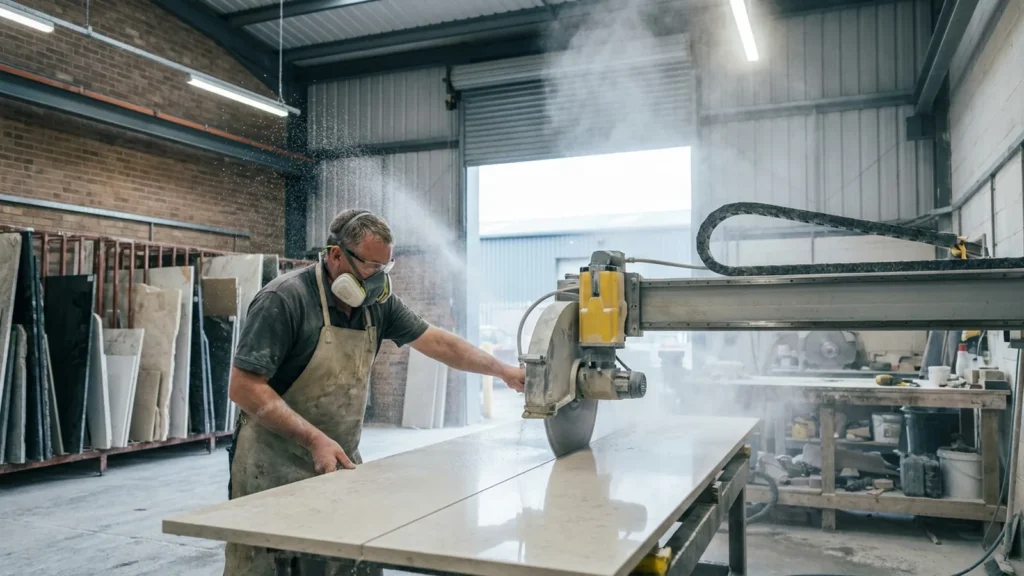

For decades, asbestos was the material of choice for insulation, lagging, ceiling tiles, brake linings, cable wrapping and thousands of other products. Workers used it without protection. Many of those workers, and their families, are only now living with the consequences.
If you or someone you love has been told they have an asbestos-related disease, this article is a starting point. It is written in plain English, with the information UK families most often ask about.
What is asbestos, and why is it so harmful?
Asbestos is the name for a group of naturally occurring fibrous minerals that were used widely in UK construction and industry from the 1930s until they were finally banned in 1999. When asbestos materials are disturbed, microscopic fibres are released into the air. Once inhaled, they can lodge in the lining of the lungs (the pleura) or in the lung tissue itself, where they can sit for 20 to 50 years before causing disease.
The Health and Safety Executive recorded 2,218 mesothelioma deaths in Great Britain in 2023, a fall of 62 on the previous year, with the long-term annual figure sitting around 2,500 deaths through the 2010s (HSE, “Mesothelioma statistics for Great Britain, 2025,” published July 2025). A similar number of asbestos-related lung cancer deaths and several hundred asbestosis deaths are recorded every year. Together, asbestos-related illness still causes around 5,000 deaths a year in Great Britain, one of the highest figures in the developed world (HSE, “Asbestos-related disease statistics, Great Britain 2025,” published November 2025).
Which asbestos diseases can be claimed for?
There are four main asbestos-related conditions handled by industrial disease solicitors:
- Mesothelioma: an aggressive cancer of the lining of the lung (or, less commonly, the abdomen). Almost every case is caused by past asbestos exposure. Even brief or low-level exposure can be enough.
- Asbestosis: progressive scarring of the lung tissue from prolonged inhalation of asbestos fibres. It causes breathlessness and a persistent cough.
- Pleural thickening: scarring and thickening of the lining of the lungs. Pleural thickening is a condition where the lining around the lungs becomes hardened, making it harder to breathe and causing chest pain.
- Asbestos-related lung cancer: lung cancer caused or significantly contributed to by asbestos exposure. Where someone has also smoked, the so-called Synergistic Effect (the way asbestos and tobacco smoke multiply each other’s risk, rather than simply adding up) often plays a role in establishing the claim.
Who is most at risk from past asbestos exposure?
Anyone who worked in an environment where asbestos was disturbed, cut, drilled, sanded or lagged, often without protection, is potentially at risk. Common UK industries include:
- Shipbuilding and ship repair, particularly across the North East, Merseyside, the Clyde, and the south coast yards
- Construction, demolition and refurbishment of buildings put up before 2000
- Telecommunications and cable work, including former BT, Post Office Telephones and GPO engineers who handled asbestos-wrapped cables and junction boxes
- Power generation, including former CEGB power stations
- Heavy engineering and manufacturing, including boiler makers, laggers, pipefitters and instrument engineers
- Joinery, plumbing and electrical trades working on older buildings
- Schools, hospitals and public buildings where asbestos remains in situ
Family members can also develop mesothelioma from “secondary” exposure (for example, washing a partner’s overalls covered in asbestos dust). These cases are recognised in UK law.
Why is asbestos still such a live issue in 2026?
Asbestos was banned in the UK in 1999, but the legacy material was never removed from most buildings put up before that date. The Department for Education’s Asbestos Management Assurance Process found that 81% of schools in England still contain asbestos, and asbestos remains in around 300,000 non-domestic UK buildings, including hospitals, public estate and older offices (UK Parliament, Work and Pensions Committee, “Government response on asbestos management,” 2024).
In February 2025, the HSE’s Chief Executive told the Work and Pensions Committee that the removal of asbestos should be the long-term goal, a notable shift from the previous “manage in place” position. For workers exposed decades ago, that does not change the legal position: the obligations on past employers, and the right to bring a compensation claim, remain unchanged.

How do UK asbestos compensation claims work?
A claim is brought against the employer (or employers) whose negligence exposed you to asbestos, and in practice against their employers’ liability insurer. The aim is to establish that the employer knew or should have known the dangers, failed to take reasonable steps to protect workers, and that this failure caused or materially contributed to the disease.
For mesothelioma, the law goes a step further. Under Section 3 of the Compensation Act 2006, where mesothelioma has been caused by exposure during multiple periods of employment, each negligent employer is jointly and severally liable for the whole loss. In plain English, that means a victim can recover 100% of their compensation from any one liable employer or insurer, even if others cannot be traced or have gone out of business.
What is the time limit, and what is “date of knowledge”?
Asbestos claims are subject to the Limitation Act 1980. The general rule is three years, but the clock does not start on the day you were exposed. It starts on the date of knowledge under Section 14 of the Act, broadly the date you first knew, or could reasonably have known:
- That you had a significant injury or illness
- That it was attributable to the conduct of someone (in most cases, a former employer)
- The identity of that person
For asbestos diseases that often means the date of formal diagnosis. Where the person affected has sadly passed away, family members typically have three years from the date of death to bring a claim, and the courts have a discretion (Section 33) to allow claims outside the standard window in appropriate cases.
What if the old employer has gone out of business?
This is one of the most common worries we hear, and it rarely ends a claim. Two routes commonly apply:
- Insurance tracing: UK employers were required to carry employers’ liability insurance for most of the relevant period. Specialist solicitors can search the Employers’ Liability Tracing Office and industry-specific archives to identify the insurer who was on cover for the relevant years.
- The Diffuse Mesothelioma Payment Scheme (DMPS): for mesothelioma cases where no employer or insurer can be traced, the DMPS, set up by the Mesothelioma Act 2014 and administered by the government, makes a one-off lump-sum payment to eligible sufferers and their dependants (gov.uk, “Diffuse mesothelioma payment scheme”).
You may also be entitled to Industrial Injuries Disablement Benefit (IIDB) from the Department for Work and Pensions if you have a prescribed asbestos-related disease, regardless of any civil claim (gov.uk, “Industrial Injuries Disablement Benefit”).
How much compensation could be awarded?
Asbestos compensation is set with reference to the Judicial College Guidelines, 18th edition, published on 9 April 2026. This is the most recent edition used by the courts, and applied an uplift of approximately 8.26% to all brackets to reflect movement in the Retail Prices Index up to August 2025. Final figures vary substantially based on diagnosis, prognosis, age, pain and suffering, the impact on the family, and the financial losses involved.
| Condition | Indicative bracket (general damages) |
|---|---|
| Mesothelioma | Around £92,000 to £167,800+ |
| Asbestos-related lung cancer | Around £97,400 to £138,600 |
| Asbestosis (depending on lung function impact) | Around £19,500 to £132,100 |
| Pleural thickening (depending on symptoms) | Around £19,500 to £72,500 |
These are general damages only. Total settlements in mesothelioma and serious asbestos cases routinely run well into six figures once past and future loss of earnings, care costs, treatment, equipment, and home adaptations are taken into account.
What does WE Solicitors do for asbestos clients?
WE Solicitors has handled asbestos disease cases since 2001. The firm has recently settled two significant cases on behalf of clients: a mesothelioma claim arising out of work in a North East shipbuilding company, and an asbestosis claim involving exposure during employment with BT. Both involved exposure decades before diagnosis, both involved tracing the right insurer, and both were resolved without our clients ever having to set foot in a courtroom.
You will work directly with a specialist solicitor who will:
- Take a free, no-pressure phone call to listen and assess
- Help gather your work history and medical records
- Arrange a specialist medical examination where needed
- Trace the relevant employers and insurers, including dissolved companies
- Pursue the civil claim, IIDB, and where appropriate the DMPS, alongside each other
- Prepare urgent (“expedited”) proceedings where life expectancy means time is short
All asbestos disease claims are handled on a No Win, No Fee basis.
Frequently asked questions about UK asbestos claims
My relative has been diagnosed with mesothelioma and is very unwell. How quickly can a claim be progressed?
Where prognosis is short, the courts allow for expedited mesothelioma claims that can move from instruction to settlement in months rather than years. Speak to a specialist as soon as possible after diagnosis.
Can a claim still be made if my loved one has passed away?
Yes. Where someone has died from an asbestos-related disease, eligible family members can bring a claim. The three-year time limit runs from the date of death, and the courts have a discretion to extend it.
Will I have to remember exactly when and where I was exposed?
Not in fine detail. Your solicitor will work with you to reconstruct your work history. Personnel records, HMRC employment records, union records, and witness statements from former colleagues all help.
Do I have to be British or live in the UK to claim?
You do not have to be British. What matters is where the exposure happened and where the negligent employer was based. Many UK asbestos claims are brought by people who now live abroad after working in British industry.
Will making a claim affect my benefits?
A civil compensation award does not affect IIDB. It can interact with means-tested benefits in some circumstances, and we will flag this early so you can take the right advice.
Take the next step, on your terms
A free, confidential phone call with a specialist solicitor is the simplest way to find out where you stand. There is no obligation and no pressure. Call 0800 294 3065 or use our online contact form and a member of the team will get back to you.
Sources: HSE, “Mesothelioma statistics for Great Britain, 2025,” published July 2025 (hse.gov.uk/statistics/assets/docs/mesothelioma.pdf) · HSE, “Asbestos-related disease statistics, Great Britain 2025,” published November 2025 (hse.gov.uk/Statistics/assets/docs/asbestos-related-disease.pdf) · UK Parliament Work and Pensions Committee, Government response on asbestos management, 2024 (committees.parliament.uk) · Control of Asbestos Regulations 2012 (legislation.gov.uk/uksi/2012/632) · Compensation Act 2006, section 3 (legislation.gov.uk/ukpga/2006/29/section/3) · Limitation Act 1980, sections 11, 14 and 33 (legislation.gov.uk/ukpga/1980/58) · gov.uk, “Diffuse mesothelioma payment scheme” · gov.uk, “Industrial Injuries Disablement Benefit” · Judicial College Guidelines for the Assessment of General Damages in Personal Injury Cases, 18th edition, 9 April 2026 (Judicial College, Oxford University Press) · Mesothelioma UK Research Centre (mesothelioma.uk.com).