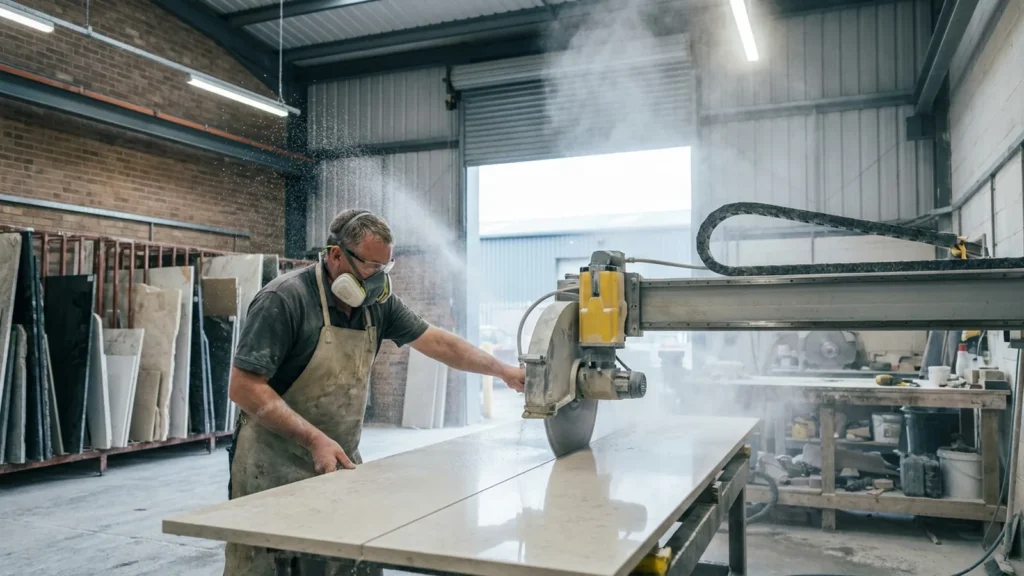
Sheffield earned the name Steel City through crucible steel, forging, rolling and cutlery grinding, and the Rotherham melting shops of the Don Valley made steel on a scale unmatched in Europe. Those trades exposed generations of workers to drop-hammer and furnace noise, asbestos lagging on furnaces, ladles and steam pipes, silica dust from grinding, and the vibration of fettling and grinding tools. The illnesses that followed include noise-induced hearing loss and tinnitus, mesothelioma, asbestosis, pleural thickening, silicosis and hand-arm vibration syndrome (HAVS). Because these conditions appear years after the exposure ended, former steelworkers and their families can still bring industrial disease claims in Sheffield and across South Yorkshire today. WE Solicitors has handled hearing loss claims and asbestos claims for workers across the North of England since 2001.
Steelmaking in Sheffield was first recorded in 1692, and in the 1740s the clockmaker Benjamin Huntsman produced the first crucible cast steel, an invention that Sheffield Museums describes as the foundation of the city’s world-renowned steel industry. By the late nineteenth century the city’s output was overshadowed by mechanised mills in the United States and Germany, but Sheffield kept its reputation by making specialist steels, and its heavy works in the Lower Don Valley turned to armour plate and armaments. The scale is captured by the River Don Engine, preserved at Kelham Island Museum: built in 1905 and rated at 12,000 horsepower, it drove a rolling mill that produced armour plate up to 40 centimetres thick and 50 tons in weight for the shipbuilding industry. Downstream at Templeborough in Rotherham, a steelworks built during the First World War grew into the largest in Europe, with eleven open-hearth furnaces and a row of chimneys known locally as the Fourteen Sisters. Six electric arc furnaces replaced the open hearths in 1965, making it the world’s largest electric steel plant, and the works cast its last steel on 25 November 1993. The furnaces are cold, but the diseases they left behind are still being diagnosed.
Which Sheffield and South Yorkshire industries caused industrial disease?
Almost every stage of steel and cutlery production in Sheffield and Rotherham carried a recognised risk of noise, dust, asbestos or vibration, and the same hazards ran through the engineering, wire and tool firms that grew up around the big works in Attercliffe, Brightside, Tinsley and Templeborough. These are the workplaces we hear about most often in enquiries about industrial disease in Sheffield.
- Melting shops and furnaces: open-hearth and electric arc furnaces, ladles and casting pits, where asbestos was used as heat insulation on furnace linings, ladle covers, pipework and protective clothing, and where the noise of charging and tapping never stopped.
- Drop forges and hammer shops: steam and pneumatic hammers striking hot billets many times a minute, producing impulsive noise far above today’s limits, followed by the fettling of forgings with hand-held grinders.
- Rolling mills: continuous noise from the mill stands, hot saws and roller tables, with asbestos lagging on steam pipes, boilers and soaking pits.
- Cutlery, tool and saw grinding: sandstone grindstones produced silica dust for two centuries, and powered grinding and polishing later added noise and hand-arm vibration.
- Foundries and fettling shops: knocking out castings and dressing them with chipping hammers and grinders, a textbook source of hand-arm vibration, in air carrying silica from moulding sand.
- Maintenance, boiler and lagging trades: fitters, boilermakers, electricians, bricklayers and laggers who stripped and replaced asbestos insulation on furnaces, kilns and steam plant, and the labourers who swept up after them.
How noisy were Sheffield’s forges and steelworks, and can I make a steelworks hearing loss claim?
Yes. If you worked in a forge, melting shop, rolling mill or grinding shop and now have hearing loss or tinnitus, you can make a steelworks hearing loss claim provided your employer failed to protect you from the noise. The Control of Noise at Work Regulations 2005 set a lower exposure action value of 80 dB(A) averaged over a working day or week, an upper exposure action value of 85 dB(A) and an exposure limit value of 87 dB(A), with separate peak limits of 135, 137 and 140 dB(C) for impulsive noise such as a hammer blow. Those regulations replaced the Noise at Work Regulations 1989, but the duty goes back much further. Employers have owed a general duty of care under the Health and Safety at Work etc. Act 1974, and the Ministry of Labour’s 1963 booklet Noise and the Worker is usually treated by the courts as the date from which employers should have known about the danger. In practice, noise exposure in a Sheffield or Rotherham works from 1963 onwards can found a claim if hearing protection was not provided, not enforced or not explained.
The scale of the problem is still visible in national figures. HSE estimates that around 15,000 workers a year in Great Britain had work-related hearing problems, based on Labour Force Survey data averaged over 2022/23 to 2024/25, and 665 new cases of occupational deafness were assessed for Industrial Injuries Disablement Benefit between 2015 and 2024. The benefit scheme uses a strict test (a measured loss of more than 50 dB in both ears), so many people with genuine industrial deafness in South Yorkshire never appear in those statistics. A civil claim does not use that test. It relies on an audiogram (a hearing test that plots what you can hear at each pitch) showing the pattern typical of noise damage, together with a history of noisy employment. You can read more about the medical picture on our permanent noise-related hearing loss page and in our hearing loss FAQs.
What asbestos exposure did steelworkers in Sheffield and Rotherham face, and can they claim?
Steelworks were among the heaviest industrial users of asbestos because it resists heat. It was used to lag furnaces, ladles, soaking pits, boilers and steam pipes, woven into gloves, aprons and blankets for men working near molten metal, and packed into gaskets, ropes and brake linings on cranes and mill machinery. Furnace bricklayers, laggers, fitters, boilermakers and electricians handled it directly, but melters, crane drivers and labourers working in the same sheds breathed the same dust. Blue and brown asbestos were banned in 1985 and white asbestos in 1999, and HSE advises that only buildings constructed after 2000 are unlikely to contain it, so anyone who worked in an older steel or engineering building in South Yorkshire may have been exposed without ever being told. Asbestos claims in Sheffield are typically brought for mesothelioma, asbestos-related lung cancer, asbestosis and pleural thickening; each is explained in the conditions table below.
The latest HSE Asbestos-related disease statistics for Great Britain, published in July 2026, record 2,146 mesothelioma deaths in 2024, a similar estimated number of lung cancer deaths caused by past asbestos exposure, and 503 deaths mentioning asbestosis, giving a total of around 5,000 asbestos-related deaths a year. HSE’s analysis by geographical area for 1981 to 2024 records 546 male and 82 female mesothelioma deaths among Sheffield residents, and 204 male and 41 female deaths in Rotherham. Across Yorkshire and the Humber there were 5,457 male and 1,144 female mesothelioma deaths over the same period. A standardised mortality ratio (SMR) compares an area’s death rate with Great Britain as a whole after adjusting for age, with 100 meaning the national average. Sheffield’s male mesothelioma SMR across the whole period was 96.9, but it has been above 100 in every five-year period since 2010, peaking at 137 in 2010 to 2014, and Rotherham’s reached 101 in 2020 to 2024. Sheffield also has one of the highest male asbestosis rates in the country: 204 asbestosis deaths between 1981 and 2024 and an SMR of 178.6, the 34th highest of all local authority areas in Great Britain.
Where noise, asbestos, dust and vibration were found in South Yorkshire’s steel and cutlery trades
| Workplace | Typical exposure | Illness that can follow |
|---|---|---|
| Melting shop and furnaces | Furnace, charging and tapping noise; asbestos lagging, ladle covers and heat-proof clothing | Hearing loss, tinnitus, mesothelioma, asbestosis, pleural thickening |
| Drop forge and hammer shop | Impulsive hammer noise; vibrating fettling grinders | Hearing loss, tinnitus, HAVS |
| Rolling mill | Continuous mill noise; asbestos on steam pipes, boilers and soaking pits | Hearing loss, tinnitus, asbestos disease |
| Grinding hull and cutlery works | Silica dust from sandstone wheels; powered grinding noise and vibration | Silicosis, hearing loss, HAVS |
| Foundry and fettling shop | Chipping hammers and grinders; knock-out noise; silica moulding sand | HAVS, hearing loss, silicosis |
| Maintenance, lagging and boiler work | Stripping and replacing asbestos insulation on furnaces and steam plant | Mesothelioma, asbestosis, lung cancer, pleural thickening |
Swipe sideways to see the whole table
Can I make a HAVS claim in Sheffield if I used grinders and chipping hammers?
Yes, if you developed hand-arm vibration syndrome after regular use of vibrating tools at work and your employer did not control the exposure. HAVS is the medical name for permanent damage to the nerves and blood vessels of the hands and arms caused by vibration. Its best-known form is vibration white finger, where the fingertips turn white in the cold and then red and painful as they recover, and it is often accompanied by tingling, numbness, disturbed sleep and loss of grip. HSE lists grinders, sanders, hammer drills and concrete breakers among the tools responsible, warns that hammer-action tools carry a risk after about 15 minutes of use a day, and states plainly that once the damage is done it is permanent. The Control of Vibration at Work Regulations 2005 set a daily exposure action value of 2.5 m/s² A(8) and a daily exposure limit value of 5 m/s² A(8), meaning employers must act to reduce exposure once the lower figure is reached and must not allow the upper figure to be exceeded. Fettlers, dressers, grinders and maintenance fitters in the steel and forging trades often worked well beyond those figures for years before 2005, and sometimes after it.
HSE recorded 220 new cases of HAVS assessed for Industrial Injuries Disablement Benefit in 2024 and 2,860 across 2015 to 2024, almost all in men, down from 1,210 in 2010, and it acknowledges that the true annual incidence is underestimated. HAVS claims in Sheffield are open to former steelworkers as well as to construction, engineering, utility and grounds maintenance workers across South Yorkshire, and the three-year time limit runs from the point at which you knew, or should have known, that your symptoms were caused by work.
Grinders’ disease: Sheffield’s oldest industrial illness
Silicosis was killing Sheffield grinders long before it had a name. Cutlers ground their blades on sandstone wheels in water-powered mills known as wheels, whose workrooms were called hulls; a survey in 1794 counted 83 wheels with 1,475 troughs employing 1,800 grinders. Dry grinding of forks, needles and spindles threw the most dust, and the arrival of steam-driven wheels from 1786 allowed larger, airtight mills to run for fourteen to sixteen hours a day. In 1819 Sir Arnold Knight, founder of Sheffield’s medical school, reported that of 2,500 grinders fewer than 35 had reached the age of 50, and an 1857 survey of two of the largest wheels found the average age of the living fork grinders was 29. Extraction fans, composite grindstones that contained no silica and the Factory and Workshop Acts of the later nineteenth century eventually brought the disease under control, and it had almost disappeared by 1950. Silicosis has not gone away, though. It still affects people who cut stone, work with foundry sand or fabricate engineered stone worktops, and WE Solicitors handles silicosis claims alongside the steel trades’ better-known diseases.
Industrial diseases linked to Sheffield and South Yorkshire’s steel, forging and cutlery trades
| Condition | What it is | Typically appears | Claimable |
|---|---|---|---|
| Noise-induced hearing loss | Permanent damage to the inner ear from prolonged loud noise; usually affects both ears and high-pitched sounds first | During noisy work, but often only noticed years after leaving it | Yes, within three years of realising work caused it |
| Tinnitus | Ringing, buzzing or hissing in the ears with no outside source, often alongside hearing loss | Same as hearing loss | Yes, usually as part of a hearing loss claim |
| Mesothelioma | Cancer of the lining of the lung or abdomen, caused almost exclusively by asbestos | Decades after exposure | Yes, prioritised; scheme payment if no insurer can be found |
| Asbestos-related lung cancer | Lung cancer where asbestos exposure was a cause, with or without smoking | Decades after exposure | Yes |
| Asbestosis | Scarring of the lung tissue from heavy asbestos exposure, causing breathlessness | Decades after exposure | Yes, plus a possible 1979 Act lump sum |
| Pleural thickening | Scarring of the lining of the lung that restricts breathing | Decades after exposure | Yes, where it causes disability |
| Silicosis | Scarring of the lungs from breathing fine silica dust | Years to decades after exposure | Yes |
| Hand-arm vibration syndrome | Permanent nerve and blood vessel damage in the hands from vibrating tools | After months or years of regular tool use | Yes, within three years of linking symptoms to work |
Swipe sideways to see the whole table
“Sheffield men tend to tell us the noise and the dust were just part of the job. They were, but the law said the employer had to protect you from them, and it has said so since the 1960s. If you worked in a forge, a melting shop or a grinding hull and your hearing or your chest has gone, it costs nothing to find out whether you have a claim.”
How long do I have to bring an industrial disease claim in South Yorkshire?
Usually three years from your date of knowledge, not from the date you were exposed. Under sections 11 and 14 of the Limitation Act 1980, the clock starts when you first knew, or could reasonably have been expected to know, that you had a significant injury and that it was caused by something your employer did or failed to do. For most people that is the date of diagnosis, or the date a doctor first linked the condition to their work. For a fatal claim the family has three years from the date of death, or from the date they learned the cause if that came later. Courts have a discretion to extend the deadline in some circumstances, but nobody should rely on it. If a steelworker died of mesothelioma or lung cancer and the family only later learned of the asbestos connection, it is still worth asking. Our guide to the claims process explains what happens after you contact us.
What if the works has closed or the employer no longer exists?
Most of the South Yorkshire steelworks, forges and cutlery firms of the 1960s to 1990s have closed, merged or been dissolved, and that does not stop a claim. Compensation is paid by the employer’s liability insurer for the period of exposure, not by the company itself. WE Solicitors traces those historic policies through the Employers’ Liability Tracing Office database, insurer archives and evidence from former colleagues, and a company that has been struck off can be restored to the register so that a claim can be brought against its insurer. Where no insurer can be traced for a mesothelioma case, the Diffuse Mesothelioma Payment Scheme created by the Mesothelioma Act 2014 makes a payment to people first diagnosed on or after 25 July 2012 who cannot bring a claim against any employer or insurer because they cannot be found or no longer exist. Separately, the Pneumoconiosis etc. (Workers’ Compensation) Act 1979 provides a government lump sum for people disabled by pneumoconiosis (which includes asbestosis and silicosis), diffuse mesothelioma and other prescribed dust diseases, and for their dependants, where there is no employer left to claim against. We check every route, including these, for every client.
Frequently asked questions
Can I make a hearing loss claim in Sheffield if I left the steelworks decades ago?
Yes. Noise damage is permanent and the time limit runs from when you realised, or should have realised, that your hearing loss was caused by work, which for many former steelworkers is the day an audiogram confirms it. If you left a Sheffield forge or melting shop in the 1980s and were only recently told your hearing loss is noise-related, you may still be in time.
Do I need mesothelioma solicitors in Sheffield itself?
No. WE Solicitors acts for mesothelioma clients across the North of England from Oldham and handles everything by phone, email and post, meeting clients in person where that helps. Mesothelioma claims are prioritised by the courts and we start work on the day you instruct us.
What does industrial deafness in South Yorkshire look like on a hearing test?
Noise damage typically produces a dip in the audiogram at the higher pitches in both ears, which is different from the pattern of ordinary ageing. A hearing test from an audiologist, combined with your work history, is usually enough for us to say whether a claim is worth pursuing.
My father worked at a Rotherham steelworks and died of mesothelioma. Can the family claim?
Yes. A claim can be brought by the estate and by dependants within three years of the death, or of the date the family learned that asbestos was the cause. We gather his work history from records, former colleagues and the family, and trace the insurer of the works even though it has long since closed.
I used grinders in a fettling shop and my fingers go white in the cold. Is that HAVS and can I claim?
White, numb fingers after years of grinding or chipping work are the classic signs of hand-arm vibration syndrome, which a specialist doctor can confirm. If your employer did not limit your time on vibrating tools, provide low-vibration equipment or arrange health checks, you can claim, and the three-year limit runs from when you linked the symptoms to work.
Does it matter that I smoked?
Not for mesothelioma, which is caused by asbestos rather than smoking, and not for asbestosis or pleural thickening. For lung cancer, a claim can still succeed where asbestos exposure was a cause alongside smoking, although the medical evidence needs careful handling and the award may be adjusted.
Will I have to go to court?
Almost certainly not. The great majority of industrial disease claims settle with the insurer before any hearing, and where a mesothelioma case does need court involvement, the process is designed to move quickly and to spare the claimant. You can see anonymised examples on our cases settled page.
How much does it cost to start an industrial disease claim in Sheffield?
Nothing to start. WE Solicitors works on a no win, no fee basis, so you pay nothing up front and nothing if the claim does not succeed. The initial assessment of your case is free and carries no obligation.
Speak to a specialist industrial disease solicitor for Sheffield and South Yorkshire
Whether you were a melter at Templeborough, a hammer driver in an Attercliffe forge, a grinder in a Hillsborough cutlery works or a lagger who moved between the steelworks of the Don Valley, WE Solicitors can tell you quickly and honestly whether you have a claim. We have acted for workers from the North’s heavy industries since 2001, we are members of APIL, and we handle hearing loss claims, asbestos disease claims, HAVS and silicosis claims for clients across Sheffield, Rotherham, Doncaster and Barnsley. Our affected industries page covers other trades, and our cases settled page shows the kinds of outcomes we achieve. If you would rather read first, our sister site hearinglossadvice.co.uk explains noise damage in more detail.
WE Solicitors LLP is regulated by the Solicitors Regulation Authority, SRA number 445359. We are members of the Association of Personal Injury Lawyers and the Professional Negligence Lawyers Association.
Sources
The figures and legal references on this page come from the following authorities, checked at the time of publication.
- HSE, Asbestos-related disease statistics, Great Britain 2026 (July 2026), including asbestosis deaths by geographical area 1981 to 2024. https://www.hse.gov.uk/statistics/assets/docs/asbestos-related-disease.pdf
- HSE, Mesothelioma deaths by Geographical Area, 2026: deaths for local and unitary authority areas in Great Britain 1981 to 2024 (July 2026). https://www.hse.gov.uk/statistics/assets/docs/mesoarea.pdf
- HSE, MESOAREA data tables: mesothelioma deaths and SMRs by area and five-year period, 1981 to 2024 (July 2026). https://www.hse.gov.uk/statistics/assets/docs/mesoarea.xlsx
- HSE, Noise induced hearing loss statistics in Great Britain (2025 release, Labour Force Survey 2022/23 to 2024/25 and IIDB to 2024). https://www.hse.gov.uk/statistics/causdis/deafness/index.htm
- HSE, Hand-arm vibration syndrome and other vibration-related conditions statistics in Great Britain (IIDB new cases 2010 to 2024). https://www.hse.gov.uk/statistics/causdis/vibration/index.htm
- HSE, Hand-arm vibration: worried about your hands? (symptoms, tools and permanence of HAVS). https://www.hse.gov.uk/vibration/hav/yourhands.htm
- HSE, Introduction to asbestos safety (1999 ban, around 5,000 deaths a year, buildings built after 2000). https://www.hse.gov.uk/asbestos/introduction/index.htm
- The Control of Noise at Work Regulations 2005, regulation 4: exposure limit values and action values. https://www.legislation.gov.uk/uksi/2005/1643/regulation/4
- The Control of Vibration at Work Regulations 2005, regulation 4: exposure limit values and action values. https://www.legislation.gov.uk/uksi/2005/1093/regulation/4
- Limitation Act 1980, section 11: special time limit for actions in respect of personal injuries. https://www.legislation.gov.uk/ukpga/1980/58/section/11
- Limitation Act 1980, section 14: definition of date of knowledge. https://www.legislation.gov.uk/ukpga/1980/58/section/14
- Mesothelioma Act 2014, section 2: eligible people with diffuse mesothelioma. https://www.legislation.gov.uk/ukpga/2014/1/section/2
- Pneumoconiosis etc. (Workers’ Compensation) Act 1979, section 1: lump sum payments. https://www.legislation.gov.uk/ukpga/1979/41/section/1
- Cullen DR, A Review of the History of Grinders’ Asthma in Sheffield, Topics in the History of Medicine, British Society for the History of Medicine, 2022. https://bshm.org.uk/wp-content/uploads/2022/12/thom-v2-102-113.pdf
- Sheffield Museums Trust, Benjamin Huntsman clock: the first object made with crucible cast steel, 1740s. https://www.sheffieldmuseums.org.uk/whats-on/benjamin-huntsman-clock/
- Sheffield Museums Trust, Kelham Island Museum, River Don Engine (1905, 12,000 horsepower armour plate rolling mill engine). https://www.sheffieldmuseums.org.uk/whats-on/river-don-engine/
- University of Sheffield Humanities Research Institute, Materializing Sheffield: Steel City (history of Sheffield steelmaking from 1692). https://www.dhi.ac.uk/books/matshef/forging-the-cityscape/steel-city/
- Magna Science Adventure Centre, Templeborough Times: a brief history of the site (Rotherham steelworks, 1916 to 1993). https://www.visitmagna.co.uk/science-adventure/history-of-steel/templeborough-times-a-brief-history-of-the-site/
- Magna Science Adventure Centre, Steelos after WWII (electric arc furnaces 1965, last steel cast 25 November 1993, Magna opened 2001). https://www.visitmagna.co.uk/science-adventure/history-of-steel/templeborough-times-a-brief-history-of-the-site/steelos-after-wwii/