
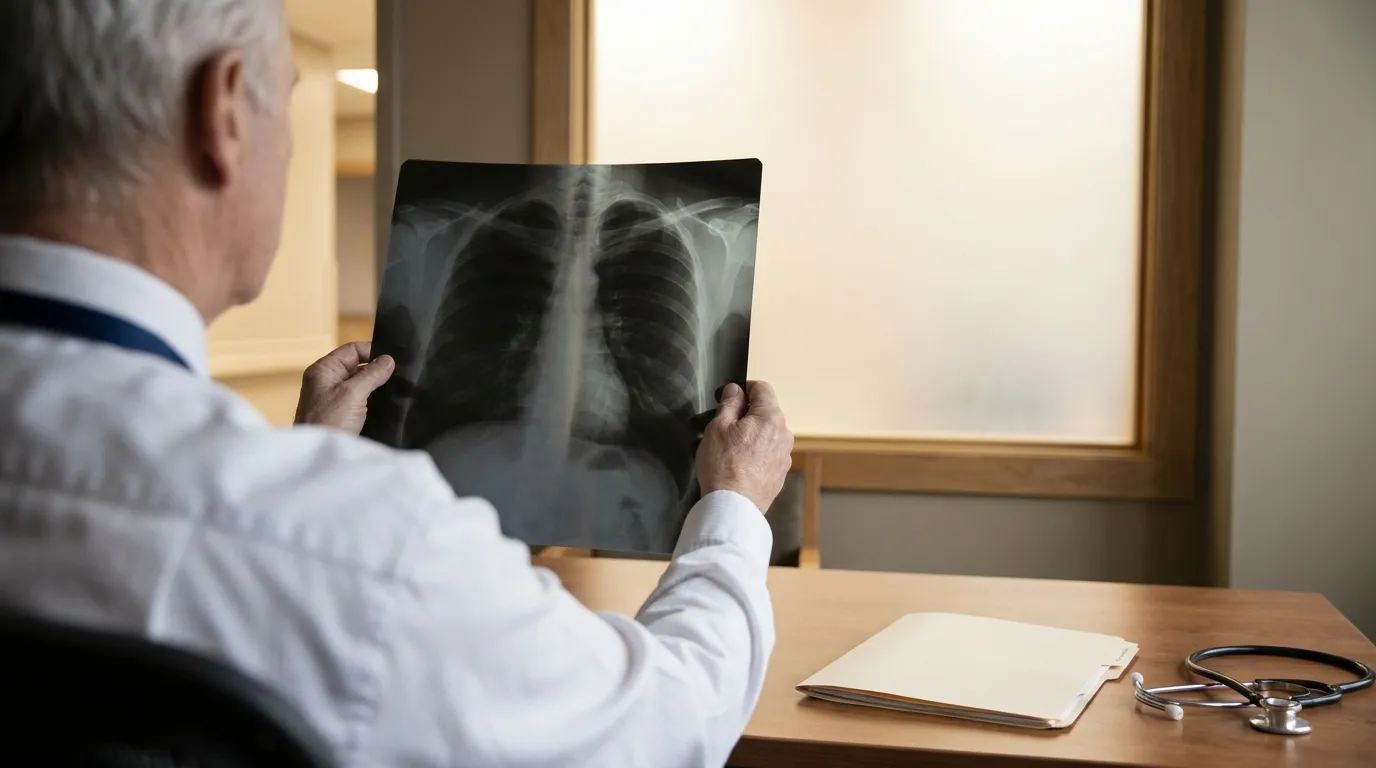
A lung cancer diagnosis is overwhelming. In the weeks that follow, most people focus on treatment, family, and getting through the next appointment. It is rare for anyone to stop and ask whether the disease might have started decades earlier, on a building site, in a power station, or on a telephone exchange floor. Many people in this situation do have a valid legal claim, and most do not realise it.
How does asbestos cause lung cancer?
Asbestos is a naturally occurring mineral that was used heavily in UK construction, manufacturing, and engineering from the 1950s until it was fully banned in 1999. When asbestos materials are damaged, cut, or disturbed, microscopic fibres are released into the air. Once inhaled, those fibres can lodge in lung tissue and stay there for decades. Over time they cause inflammation, scarring, and genetic damage that can develop into cancer.
According to the Health and Safety Executive, asbestos is still the largest single cause of work-related deaths in the UK. Around 5,000 people die each year from asbestos-related diseases, and roughly half of those deaths are from asbestos-related lung cancer rather than mesothelioma (HSE, Asbestos-related disease statistics, Great Britain 2025).
I smoked. Can I still make a claim?
Yes. This is one of the most common reasons people decide not to come forward, and it is based on a misunderstanding of how the law works.
Medical research shows that asbestos and tobacco smoke interact. Smoking alone increases your lung cancer risk by roughly ten times. Asbestos exposure alone increases it by around five times. When the two are combined, the risk does not simply add up, it multiplies. Workers exposed to both have been shown to face more than fifty times the lung cancer risk of someone with neither exposure. This is known in medical and legal circles as the Synergistic Effect.
UK courts recognise that where asbestos exposure has made a material contribution to the disease, a claim can succeed even if the claimant was a smoker. This principle was confirmed in Fairchild v Glenhaven Funeral Services Ltd [2002] UKHL 22 and has been applied in lung cancer cases since. In some cases the compensation may be reduced to reflect smoking history, but the right to bring a claim is preserved.
Which jobs and industries were most at risk?
If you worked in any of these settings before the late 1990s, there is a realistic chance you were exposed to asbestos:
- Shipbuilding and ship repair (Tyneside, Wearside, Merseyside, Clyde)
- Power generation, including the former CEGB sites and coal-fired stations
- Telecommunications engineering (including BT and former GPO exchange and cable work)
- Heavy engineering, boilermaking, and pipe fitting
- Construction, demolition, and joinery
- Railway workshops and rolling stock maintenance
- Insulation lagging and thermal contracting
- Schools, hospitals, and council building maintenance
Office workers, teachers, and carers can also have been exposed if they spent years in buildings where asbestos was disturbed during routine maintenance.
How long after exposure does lung cancer appear?
This is the part that surprises most people. Asbestos-related lung cancer typically develops between 15 and 50 years after the original exposure. Someone who worked with asbestos as an apprentice in the 1970s may only be receiving a diagnosis now. This long latency is exactly why so many cases involve employers that have closed, been sold, or been dissolved years ago.

What does the law expect employers to have done?
Even before the 1999 ban, employers had clear duties under the Health and Safety at Work etc. Act 1974 and earlier asbestos regulations. From 2012 onwards, the Control of Asbestos Regulations 2012 consolidated those duties. In practical terms, employers were and are required to:
- Identify whether asbestos is present in the workplace
- Assess the risk of exposure
- Provide proper protective equipment and respiratory protection
- Train staff working near asbestos
- Keep records of who may have been exposed
Where an employer failed to do these things, and a worker later develops an asbestos-related disease, the employer (or, more often, their historic insurer) can be held legally responsible.
What is the “date of knowledge” rule?
Under the Limitation Act 1980, Section 11, a claim must usually be brought within three years. The clock does not start ticking from the date of exposure, which is often impossible to identify. It starts from the date of knowledge: the point at which the affected person first knew, or could reasonably have known, that their illness was linked to their work.
Section 14 of the same Act sets out what “knowledge” means in practice: that the injury is significant, that it is attributable to the act or omission complained of, and the identity of the defendant. For most people, that date is the day a consultant or GP explains the likely cause of their cancer.
Even where the three-year window has already closed, Section 33 of the Limitation Act 1980 gives the court a discretion to allow a claim to proceed where it would be fair to do so. This discretion is exercised case by case, which is why early legal advice matters.
What if my old employer has gone out of business?
This is one of the most common worries, and it rarely stops a claim. Most UK employers were legally required to hold Employers’ Liability insurance from 1972 onwards. Even when the company itself no longer exists, the insurance policies usually do. WE Solicitors regularly traces historic insurers through the Employers’ Liability Tracing Office and Companies House records, and pursues the claim against the insurer rather than the dissolved business.
What does a claim actually involve?
For most people, the work falls largely on WE Solicitors rather than on the client. You can read the full service overview on our lung cancer claims page, but in summary the claim process involves:
- A free, no-obligation consultation to understand your work history and diagnosis
- Gathering medical records and arranging an independent specialist examination
- Reconstructing your employment history and identifying the responsible employer(s)
- Tracing the relevant historic insurer
- Building the evidential case, including expert reports on causation
- Negotiating settlement, or issuing court proceedings where necessary
Most claims settle without ever reaching a courtroom.
Why WE Solicitors
WE Solicitors has handled asbestos disease claims for over 25 years from its offices in the Manchester area. In the past year alone the firm has settled a mesothelioma claim against a North East shipbuilding company and an asbestosis claim brought by a former BT employee. Both are examples of the kind of work the team does every day: untangling decades of employment history, identifying the responsible insurer, and securing compensation for workers and families who thought there was nothing they could do.
WE Solicitors is SRA-regulated, APIL and PNLA accredited, and works on a No Win, No Fee basis. There are no upfront costs and no fee if the claim is unsuccessful.
Frequently asked questions
Can the family claim if the person diagnosed has died?
Yes. A claim can be brought by the estate or by dependants under the Fatal Accidents Act 1976. Time limits and procedural rules differ slightly, so it is worth speaking to a solicitor as soon as possible.
I do not remember the exact dates I worked with asbestos. Does that matter?
No. Most clients cannot recall precise dates from decades ago. HMRC, pension records, union records, and Employers’ Liability Tracing Office searches usually fill in the gaps.
Will I have to attend court?
Almost certainly not. The vast majority of asbestos-related lung cancer claims are settled through negotiation with the insurer.
How long does a claim take?
This varies. Straightforward claims can settle within months. More complex causation cases, particularly where smoking is involved, can take longer. WE Solicitors will give you a realistic timeline at the initial consultation.
I already receive Industrial Injuries Disablement Benefit. Can I still make a civil claim?
Yes. The DWP’s Industrial Injuries Disablement Benefit (IIDB) is a no-fault state benefit, paid because the disease is on the prescribed list. A civil claim against your former employer or its insurer is a separate matter and can run alongside it. The award of IIDB can also help, because it confirms that the DWP accepts the disease as work-related, which strengthens the evidential picture.
Speak to WE Solicitors
If you have been diagnosed with lung cancer and you suspect that workplace asbestos exposure may have played a part, a free conversation costs nothing and carries no obligation. Call 0800 294 3065 or use our online contact form. One of our specialist solicitors will listen, ask the right questions, and tell you honestly whether there is a claim worth pursuing.
Sources: HSE, Asbestos-related disease statistics, Great Britain 2025 · Limitation Act 1980, Sections 11, 14 and 33 · Control of Asbestos Regulations 2012 · Health and Safety at Work etc. Act 1974 · Helsinki Criteria, 2014 update · Fairchild v Glenhaven Funeral Services Ltd [2002] UKHL 22.