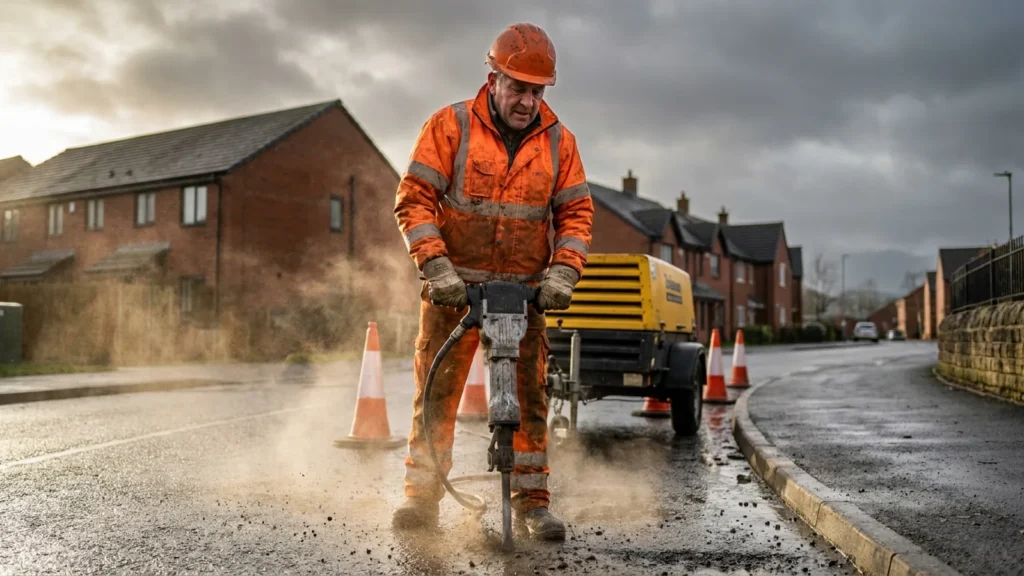
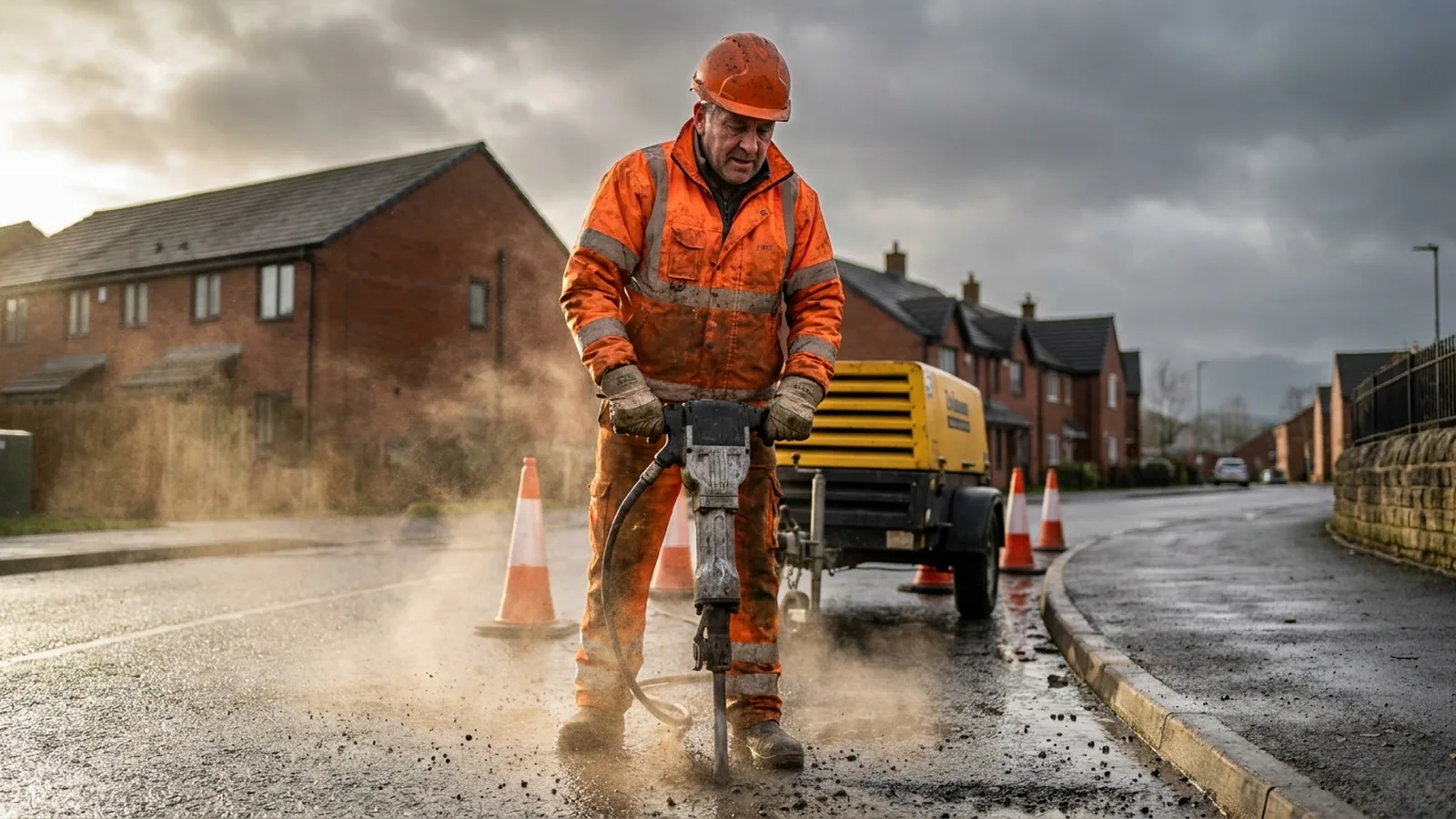
HAVS claims are compensation claims for hand-arm vibration syndrome, an injury to the nerves and blood vessels of the hands caused by regular use of vibrating tools at work, which can become permanent. If you have been diagnosed, or you have the symptoms and spent years using breakers, grinders, chainsaws or impact tools, you can usually claim against your employer’s insurer, provided you start within three years of the date you knew (or should have known) that your symptoms were work related.
This guide explains what HAVS is, who is most at risk, why the condition is so often mistaken for something else, how doctors grade it, what the law required your employer to do, and how a claim works from first phone call to settlement. It is written for the people who actually get this condition: groundworkers, road crews, fitters, foundry workers, forestry workers and engineers across the North of England.
What is hand-arm vibration syndrome and what are the symptoms?
Hand-arm vibration syndrome (HAVS) is the name for a group of conditions caused by vibration passing from a tool into the hands and arms. The Health and Safety Executive (HSE) describes the early warning signs as tingling and numbness in the fingers, not being able to feel things properly, loss of strength in the hands, and fingers going white (blanching) then becoming red and painful on recovery, particularly in the cold and wet. HSE adds that these symptoms are likely to get worse with continued exposure and may become permanent.
Doctors separate HAVS into two components:
- The vascular component, often called vibration white finger. Blood vessels in the fingers go into spasm, usually triggered by cold, so the fingertips turn white and numb, then blue, then red and throbbing as blood returns.
- The sensorineural component, which is nerve damage. It causes tingling, numbness, poor sense of touch and loss of dexterity, so fastening buttons, picking up screws or handling coins becomes difficult.
HSE also lists carpal tunnel syndrome (a trapped nerve at the wrist) as a specific disease caused by hand-arm vibration. Many people have a mix of all three. According to HSE, for some people symptoms appear after only a few months of exposure, while for others they take a few years. The Industrial Injuries Advisory Council put it more starkly in its 2023 report: one worker may develop symptoms after a year while others take 30 years despite similar exposure.
Which jobs and tools cause HAVS?
HAVS is caused by regular, frequent use of hand-held or hand-guided power tools, and by holding materials being worked by powered machinery. HSE lists the industries where the risk is greatest as building and maintenance of roads and railways, construction, estate management (grounds, parks and verges), forestry, foundries, heavy engineering, concrete product manufacture, mines and quarries, motor vehicle manufacture and repair, public utilities, and shipbuilding and repair.
The tools HSE names include chainsaws, concrete and road breakers, cut-off saws, hammer drills, hand-held and pedestal grinders, impact wrenches, jigsaws, needle scalers, polishers, power hammers and chisels, powered mowers and sanders, scabblers, and strimmers and brush cutters. HSE’s forestry guidance adds clearing saws, hedge trimmers, stump grinders, earth augers and cultivators.
The numbers show how much of a problem this remains. HSE’s latest statistics (updated January 2026) record 220 new cases of HAVS assessed for Industrial Injuries Disablement Benefit in 2024, down from a peak of 1,210 in 2010. Between 2015 and 2024 there were 2,860 assessed cases in total, and only five of them were women, reflecting who has done this kind of work. Because the benefit figures only capture people who applied and met a strict threshold, the true number affected is higher. The independent patient information service Patient reports that up to one in ten people who work regularly with vibrating tools may develop HAVS.
Why is HAVS so often blamed on Raynaud’s or age?
Because the white-finger attacks look identical to Raynaud’s phenomenon, and because many sufferers are in their fifties and sixties. The NHS Raynaud’s page itself states that Raynaud’s is sometimes caused by working with vibrating tools for a long time. In other words, vibration white finger is a form of Raynaud’s, but one with a work-related cause and, usually, a person who is legally responsible for it.
In practice, many of the people who contact us were told years ago that they had “a bit of Raynaud’s”, or “poor circulation”, or that pins and needles were just part of getting older. The link to decades of tool use was never made. That matters for two reasons. First, continuing exposure makes the damage worse. Second, the moment a doctor tells you that your hands are damaged by vibration at work is normally the moment the three-year clock for a claim starts, so it is worth getting a proper answer sooner rather than later.
What did the law require my employer to do?
The Control of Vibration at Work Regulations 2005 came into force on 6 July 2005. Regulation 4 sets two figures, both measured as a daily exposure averaged over an eight-hour day, written as A(8):
- An exposure action value of 2.5 m/s² A(8). Above this, the employer must introduce technical and organisational measures to reduce exposure, and must provide health surveillance for workers likely to be regularly exposed above it.
- An exposure limit value of 5 m/s² A(8), which HSE says should not be exceeded.
HSE’s guidance for employers is clear that they must assess the risk, identify measures to eliminate or reduce it, make sure controls are properly applied, and provide information, training and health surveillance. Health surveillance means regular checks by a doctor or nurse so that early symptoms are picked up before they become disabling. If you used vibrating tools daily after 2005 and were never asked about your hands, that alone tells a solicitor a great deal.
The 2005 Regulations did not create the duty from nothing. Employers have had a general duty to protect workers’ health under the Health and Safety at Work etc. Act 1974, and the dangers of vibrating tools were well known in industry long before 2005. Claims for exposure in the 1970s, 1980s and 1990s are regularly brought and settled.
How is HAVS graded, and what does that mean for compensation?
The standard grading system is the Stockholm Workshop Scale, which the Society of Occupational Medicine confirms remains the accepted classification used by HSE. It scores the vascular and sensorineural components separately, for each hand. A medical expert instructed in your claim will use it, alongside a history of your tool use and clinical tests.
| Stage | Vascular (blood vessel) component | Sensorineural (nerve) component |
|---|---|---|
| 0 | Exposed to vibration, no white-finger attacks | Exposed to vibration, no tingling or numbness |
| 1 | Attacks affecting only the tips of one or more fingers | Intermittent tingling or numbness, normal results on sensory testing |
| 2 | Attacks reaching the middle section of one or more fingers; “early” (three or fewer a week) or “late” (more frequent) | Intermittent tingling or numbness with reduced feeling on examination |
| 3 | Frequent attacks affecting all sections of most fingers, all year round | Persistent tingling or numbness with reduced feeling and reduced dexterity, even when warm |
Compensation for the injury itself (called general damages) is assessed using the Judicial College Guidelines, the reference book judges use. The current 18th edition was published on 9 April 2026. Its vibration white finger and HAVS chapter has four brackets, and where you fall depends on how bad the symptoms are, how many fingers are affected, your age and the effect on work and home life. The figures are revised with each edition, so rather than quote numbers that date we explain the bracket that applies to you at your free assessment.
| JCG bracket | Typical picture |
|---|---|
| Most serious | Persistent symptoms in both hands in a younger person, with a significant effect on daily life and employment |
| Serious | Marked interference with work and home activities; attacks throughout the year |
| Moderate | Attacks mainly in colder weather; employment maintained, perhaps with changes in duties |
| Minor | Occasional symptoms in a few fingers with a modest effect on life |
On top of general damages you can claim financial losses (special damages): lost earnings if you had to leave heavy work, the cost of help with tasks you can no longer do, and equipment such as heated gloves. Our page on how much your claim is worth explains how the two parts fit together.
What is the time limit for a HAVS claim?
Three years from your “date of knowledge”, not from when you used the tools. Section 11 of the Limitation Act 1980 gives three years from the date the cause of action accrued or, if later, the date of knowledge. Section 14 defines that as the date you first knew that your injury was significant, that it was attributable to your employer’s acts or omissions, and who the employer was. Knowing that the law was broken is not required; knowing the facts is enough.
For most people that date is a diagnosis, or a conversation with a GP or occupational health nurse that connects the hands to the tools. If your symptoms started long ago but nobody made the link until recently, you may still be within time. If more than three years have passed since a diagnosis, do not assume it is too late: the court has a discretion to allow a late claim, and the sooner you ask, the better your position.
How does a HAVS claim work?
- Free assessment. You tell us about your work, the tools you used, for how long each day, and your symptoms. There is no charge and no obligation.
- Exposure history. We build a written record of each job, employer and tool, with dates. Workmates, payslips, HMRC employment records and old photographs all help.
- Medical evidence. An independent specialist examines you, grades your condition on the Stockholm Workshop Scale and confirms whether vibration at work caused it. We arrange and fund this.
- Tracing the insurer. Claims are paid by the employer’s liability insurer, not the employer. The Employers’ Liability Tracing Office runs a database of policy records so that claimants and their solicitors can find the insurer for old policies. If the company has been dissolved, section 1029 of the Companies Act 2006 allows a person with a potential legal claim against it to apply to have it restored to the register so the claim can proceed.
- Letter of claim and negotiation. We set out the case to the insurer. Most HAVS claims settle without a court hearing. If the insurer will not make a fair offer, we issue proceedings.
- Settlement. On a no win, no fee basis you pay nothing if the claim fails, and an agreed percentage of compensation if it succeeds. Details are on our claims process page.
“Most of the men who come to us with HAVS have been putting up with it for years because they were told it was Raynaud’s or just their age. Once you look at what they were holding eight hours a day, the cause is obvious. The employer’s insurer knows that too, which is why these claims are usually resolved without anyone going near a courtroom.”
Steve Evans, Senior Partner, WE Solicitors LLP
Frequently asked questions
Can I make a HAVS claim if my employer has closed down?
Yes. The claim is against the insurer that covered the employer at the time, and the insurer’s obligation survives the company. A dissolved company can be restored to the register under section 1029 of the Companies Act 2006 for the purpose of the claim.
Can I claim if I still work for the same employer?
Yes. Compensation is paid by the employer’s insurance, and employers are required by law to hold employers’ liability cover for exactly this purpose. Many of our HAVS clients are still in work.
I was told I have Raynaud’s. Can I still claim?
Very possibly. The NHS lists working with vibrating tools for a long time as one cause of Raynaud’s. If your history fits, a medical expert can assess whether your Raynaud’s is in fact vibration white finger caused by work.
Do I need a formal diagnosis before I contact a solicitor?
No. We can arrange an independent medical examination as part of the claim. If you have the symptoms and a history of tool use, get in touch first and we will take it from there.
What if I used vibrating tools for several different employers?
A claim can be brought against more than one employer, and responsibility is shared between their insurers in proportion to the exposure each caused. We handle the tracing and apportionment.
Does HAVS get better?
Nerve and blood vessel damage may improve if exposure stops early enough, but where symptoms are established they often persist even after you stop. Stopping or reducing exposure as soon as symptoms appear gives the best chance of limiting the damage.
Speak to a specialist HAVS solicitor
WE Solicitors has handled industrial disease claims for workers across Greater Manchester and the North of England since 2001. We are regulated by the Solicitors Regulation Authority (SRA number 445359), members of the Association of Personal Injury Lawyers, and every HAVS claim is run on a no win, no fee basis with a free initial assessment. If your hands tingle, go numb or turn white, and you have spent years with a vibrating tool in them, call 0800 294 3065 or complete our online enquiry form. You can also read more about our HAVS claims service and the industries we most often act for.
Sources: HSE, Hand-arm vibration: advice for employers; HSE, Control of Vibration at Work Regulations 2005; Control of Vibration at Work Regulations 2005, regulation 4; HSE, Hand-arm vibration in Great Britain statistics, updated January 2026; HSE, How employers can protect workers from hand-arm vibration; HSE, Hand-arm vibration in forestry and arboriculture; Limitation Act 1980, section 11; Limitation Act 1980, section 14; Companies Act 2006, section 1029; NHS, Raynaud’s; Society of Occupational Medicine, Staging of Hand Arm Vibration Syndrome, 2022; Patient, Hand-arm Vibration Syndrome, reviewed 2024; Industrial Injuries Advisory Council, Hand-arm vibration syndrome and assessment of vibration exposure, 2023; AXA, The Employers’ Liability Tracing Office; Weightmans, The 18th edition of the Judicial College Guidelines, April 2026.