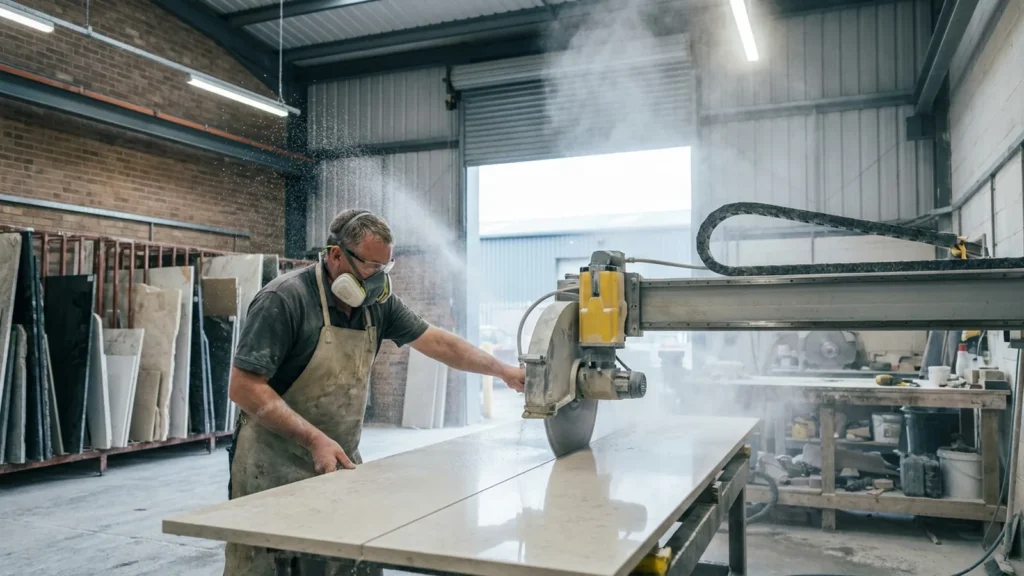
Joe Mitchell was working in the demolition industry in 2018 when he was involved in a serious and life changing accident. At the time, he was working on the sixth floor of a building, carrying out asbestos removal. This type of work is inherently hazardous due to the risk of asbestos contamination and the serious health consequences associated with exposure to asbestos. However, the accident that Joe suffered had nothing to do with asbestos removal, his accident was once that should never have happened.
The accident
Joe was working on the upper roof, wearing wellingtons. He was walking across the roof and his left foot suddenly slipped into an open brick duct. Inside the duct was asbestos-containing ducting, which housed the supply pipes for the building.
As his foot became trapped in the duct, he lost his balance and fell. His foot remained wedged in the duct while the rest of his body fell towards the surrounding walkway, which was at a lower level than the roof on which he had been working.
There was no scaffolding, guard rail, barrier or other form of collective protection in place to prevent his fall. As a result, Joe suffered a catastrophic injury to his left leg.
The injuries
The emergency services were called, the hazard response team were alerted as they had to go to the accident scene and decontaminate the area. Joe also needed to be decontaminated and he had to wait over two hours before the ambulance could take him away.
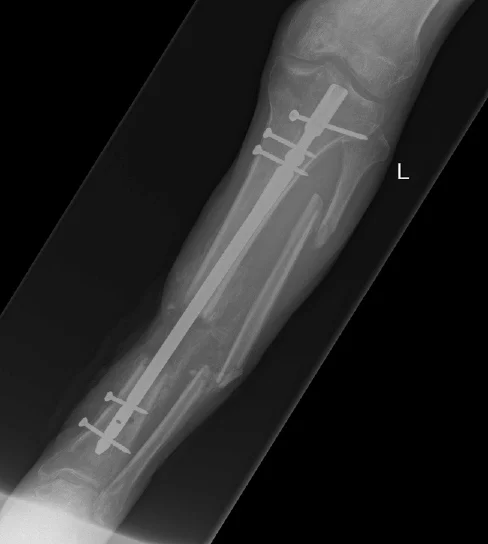
Joe suffered devastating injuries to his left leg, including fractures to his tibia and fibula, as well as a severe open wound. His foot had been twisted into an abnormal position, and the extent of his injuries meant that he required urgent surgery in an attempt to repair the multiple fractures and stabilise his leg.
A few days later, Joe underwent further major surgery, which involved the insertion of metal rods and plates, together with skin and muscle grafts to repair the extensive damage.
Following the accident, Joe spent more than three weeks in hospital. During this time, his condition was so serious that he spent several days in the high dependency unit. The severity of his injuries and the extensive treatment he required made this an extremely difficult and traumatic period for Joe.
What happened next
As time went on, Joe realised that returning to work was likely to be a significant challenge. His leg had begun to bend outwards and, as a result, he required further surgery. He also underwent steroid injections in an attempt to manage his ongoing symptoms.
Over time, Joe developed significant back pain and began experiencing problems with both of his elbows. The injuries to his left leg have also left it noticeably shorter than his right leg, meaning that he now has to wear specially built-up shoes to compensate for the difference in leg length.
Before the accident Joe was extremely passionate about fitness and had led a very active lifestyle. He had worked as a personal trainer and professional boxer, attended the gym every day and gave boxing classes. He took great pride in keeping himself fit and was always in excellent shape. The accident brought this important part of Joe’s life to an abrupt end.
He has been unable to return to the fitness activities that once played such a significant role in his life, which has been a major source of frustration and loss for him. He also has three children and five grandchildren and whilst he can still do some things with his family, it is nowhere near close to the relationship that he would like – he would like to be able to do so much more, but his injuries prevent him from doing so.
The legal process
Joe had initially instructed a law firm to pursue a compensation claim on his behalf. However, part way through the claim, he received a call informing him that the firm was experiencing difficulties and was about to ‘go bust’.
Shortly afterwards, Joe was contacted by WE Solicitors who had been assigned to take over the conduct of his case. By this stage, he had already received an offer of settlement but it was felt that the amount offered was wholly inadequate and in no way reflected the seriousness of his injuries, the impact they had on his life or his ongoing difficulties.
Joe openly acknowledges that he was not always the easiest of clients and that there were times when he had disagreements with his legal team. However, he speaks very highly of Steve Evans, the solicitor who took over his case.
The end of the case
Joe said that Steve took considerable time and care in explaining the position to him, particularly in relation to the settlement figures that had been offered and the potential risks involved if the case were to proceed and ultimately not go in his favour. Joe really appreciated the time that Steve took to make sure he fully understand the situation and the options available to him.
Joe spoke very highly of Rachel Johnston, the legal assistant who worked alongside Steve on the case. He said that he had developed an excellent rapport with Rachel and really appreciated the support and communication he received from her throughout the process.
Overall, Joe said that he was extremely happy with the way Steve and Rachel progressed his claim and was very pleased with the settlement that was ultimately achieved.